Microneedling Needle Depth: The Complete At-Home Guide
Microneedling needle depth determines which layer of skin you reach and how intense the treatment is. For at-home use, 0.5 mm is the sweet spot. It reaches the upper dermis, where the skin's collagen-producing cells sit, while staying safe with sterile, single-use needles. Depths of 1.0 mm and beyond belong in a clinic.
In this article
- Why microneedling needle depth matters
- Needle depth explained, level by level
- Why 0.5 mm with Sonicated Hyaluronic Acid makes sense
- Derma roller vs microneedling applicator
- Microneedling vs micro-infusion
- Why sterile single-use needles are essential
- Why HoMEso uses 24K gold-plated needles
- Which needle depth is best for different skin goals?
- Why deeper is not always better
- Why HoMEso uses a 0.5 mm applicator
- How often should you use 0.5 mm microneedling?
- Who should avoid microneedling?
- Final takeaway
- FAQ: Microneedling needle depth
Why microneedling needle depth matters
When it comes to microneedling, the most important question is not only whether it works, but also how deep the needles go.
Needle depth determines whether the treatment works mostly on the surface of the skin or reaches deeper layers where stronger skin-repair responses may occur. This is why searches such as microneedling needle depth, microneedling needle size, 0.5 mm vs 1.0 mm microneedling, and best needle length for face microneedling are so common.
The problem is that the internet is full of conflicting advice. Some people recommend 1.0 mm for home use, others say 0.25 mm is enough, and many forums compare derma rollers, microneedling pens and micro-infusion devices without explaining the real safety differences.
The truth is simple: for at-home use, the goal is not to go as deep as possible. The goal is to find the right balance between effectiveness, safety and skin recovery.
For most at-home facial routines, 0.5 mm is the most balanced choice. It is more active than 0.25 mm, but much more controlled and suitable for home use than 1.0 mm or deeper needles. If you are completely new to the technique, start with our complete guide to microneedling at home. And if you are still deciding between treating at home and visiting a clinic, see how microneedling compares to Botox, fillers and laser.
Needle depth explained, level by level
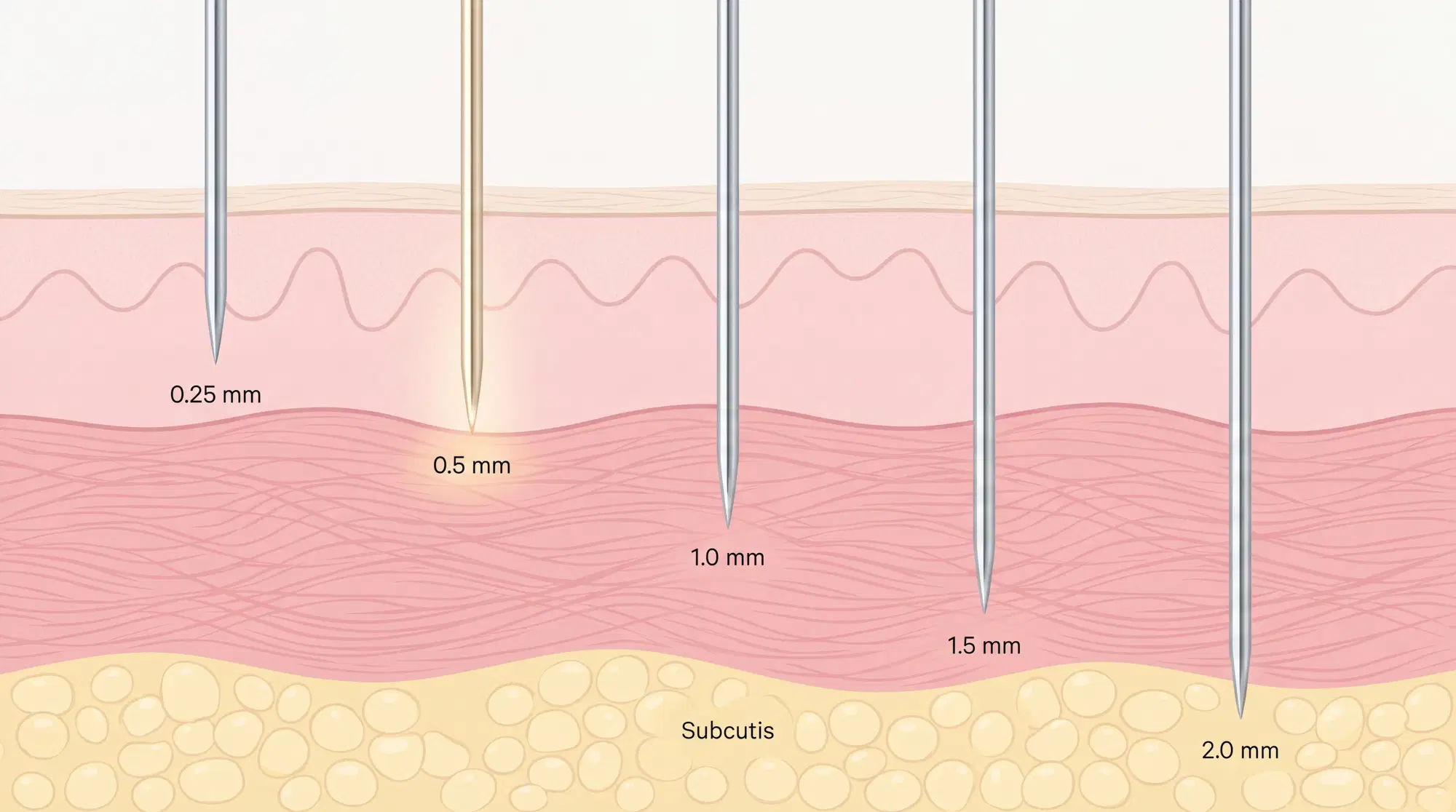
Here is what each depth reaches at a glance, before we look at each one in detail.
| Needle depth | Skin layer it reaches | Best suited to | Where to use it |
|---|---|---|---|
| 0.25 mm | Epidermis (surface) | Serum absorption and a gentle refresh | Home, for sensitive skin and frequent gentle use |
| 0.5 mm | Upper (papillary) dermis | Texture, pores, fine lines and glow | Home, the sweet spot with sterile single-use needles |
| 1.0 mm | Deeper papillary dermis | Stronger response, but more redness, bleeding and risk | Professional only, not advised at home |
| 1.5 mm | Reticular dermis | Aggressive collagen work and scar revision | Clinic only, needs anaesthesia and a sterile setting |
| 2.0 to 2.5 mm | Deep dermis | Deep scar and stretch-mark procedures | Clinic only, an invasive medical treatment |
0.25 mm microneedling: gentle but very superficial
A 0.25 mm needle depth is the most superficial option. It mainly works on the upper layers of the skin and is often used to support the absorption of skincare products.
This depth can be a good option for beginners or for people who want a very gentle treatment with minimal downtime. It may help the skin feel fresher, smoother and more hydrated, especially when paired with a suitable serum.
However, 0.25 mm is limited. It is usually too shallow if the goal is to improve the appearance of enlarged pores, uneven texture, fine lines or visible skin irregularities. In simple terms, 0.25 mm is gentle, but often too mild.
0.5 mm microneedling: the best balance for at-home use
A 0.5 mm needle depth is often considered the sweet spot for at-home cosmetic microneedling. It is deep enough to go beyond very superficial skincare, reaching the upper dermis where the skin's collagen-producing cells sit, but still controlled enough for responsible home use when the device is sterile, single-use and used correctly.
This makes 0.5 mm ideal for people who want to improve the appearance of enlarged pores, uneven texture, dull skin, fine lines, roughness and loss of glow.
The key advantage of 0.5 mm is balance. It is more effective than 0.25 mm, but does not carry the same level of risk as deeper needles. Microneedling should not be a competition in depth. Deeper does not automatically mean better. In many cases, deeper simply means more irritation, longer recovery and a higher chance of unwanted side effects. That is why 0.5 mm with sterile single-use needles is the most logical choice for at-home facial microneedling.
1.0 mm microneedling: not recommended for at-home use
A 1.0 mm needle depth is not recommended for at-home microneedling. Although it is often discussed online for wrinkles, acne scars and deeper texture concerns, it is already a significantly more intensive treatment depth. It can cause more redness, bleeding, swelling, discomfort, irritation and a longer recovery period.
More importantly, 1.0 mm increases the risk of incorrect use. At this depth, technique, hygiene, pressure, skin thickness and aftercare become much more important. Mistakes can lead to inflammation, pigmentation problems, barrier damage or even scarring.
This matters especially on the face, where skin thickness varies from area to area. The skin around the eyes, upper lip and forehead is much more delicate than the cheeks, so a depth that feels tolerable in one area can be too aggressive in another. For this reason, 1.0 mm should be left to trained professionals. For at-home facial microneedling, 0.5 mm is the safer and more predictable choice.
1.5 mm and deeper: professional treatment depths
Needle depths such as 1.5 mm, 2.0 mm and 2.5 mm are professional-level depths. They are usually associated with more advanced concerns such as deeper acne scars, stronger collagen stimulation and medical or dermatological treatments. These depths should not be used at home.
At these levels, microneedling becomes much more invasive. It requires professional knowledge, sterile conditions, correct technique, proper assessment of contraindications and suitable aftercare. If you have deep acne scars, melasma, active acne, rosacea, a tendency toward hyperpigmentation or very sensitive skin, it is better to consult a qualified professional instead of experimenting with deeper needles at home.
Why 0.5 mm with Sonicated Hyaluronic Acid makes sense
After microneedling, the skin is temporarily more sensitive. This is not the right moment for harsh acids, strong exfoliants, fragrance-heavy formulas or aggressive active ingredients. Instead, the skin benefits from ingredients that support hydration, comfort and barrier recovery.
This is where Sonicated Hyaluronic Acid fits naturally into the routine. Hyaluronic acid is known for its ability to attract and bind water, helping the skin look more hydrated, smoother and fresher. When paired with a controlled 0.5 mm applicator, it supports the skin at the moment when hydration is especially important. For more on choosing the right formula, see our guide to the best serum to use with microneedling.
The goal is not to aggressively force ingredients deep into the skin. A better way to understand it is this: 0.5 mm creates controlled microchannels, while Sonicated HA provides hydrating support. This combination makes sense for at-home use because it is effective without being overly aggressive.
Derma roller vs microneedling applicator
Needle depth is not the only thing that matters. The type of device is just as important.
A derma roller has needles attached to a rolling cylinder. As it moves across the skin, the needles enter and exit at an angle. This can create more dragging, uneven pressure and unnecessary irritation. There is also a hygiene issue. Many derma rollers are reused multiple times, and even if they are cleaned or disinfected, this is not the same as using sterile single-use needles. Skin cells, serum residue, oil and microorganisms can remain on the roller.
A microneedling applicator or pen-style device works differently. It allows a more controlled vertical movement of the needles, which creates a more even and predictable treatment. For at-home use, a sterile 0.5 mm applicator is a better option than a traditional derma roller because it offers more controlled needle entry, better hygiene, more even application, less dragging on the skin and a more predictable treatment experience.
This does not mean every derma roller is automatically bad. But for safe and modern at-home microneedling, a sterile single-use applicator is the better choice.
Microneedling vs micro-infusion
Microneedling and micro-infusion are often confused, but they are not exactly the same.
Microneedling creates controlled microchannels in the skin. The goal is to support skin renewal and improve the appearance of texture, pores, fine lines and overall skin quality.
Micro-infusion pairs that needling step with the simultaneous delivery of a serum, so hydrating and cosmetic actives are carried into the skin through the same microchannels rather than only sitting on the surface.
Both approaches should follow the same basic safety principles: appropriate depth, clean technique, sterile needles and suitable ingredients. For home use, a 0.5 mm applicator with Sonicated Hyaluronic Acid offers a practical balance, the controlled renewal of microneedling combined with micro-infusion-style hydrating support.
Why sterile single-use needles are essential
Sterile needles are not a luxury. They are a safety requirement.
During microneedling, needles pass through the surface of the skin, which means hygiene is not optional.
Sterile single-use needles help reduce the risk of contamination, irritation, infection, dull needle trauma and uneven treatment.
Reusable needles or cartridges should not be used, even if they are cleaned at home. Home sanitizing is not the same as medical sterilization, and needles can become dull, bent or damaged after use even when this is not visible to the eye.
Using damaged or contaminated needles can cause more irritation and may increase the risk of unwanted skin reactions. The rule is simple: microneedling needles should be sterile, sharp and single-use.
Why HoMEso uses 24K gold-plated needles
Sterile, sharp and single-use come first. Once a needle meets those three standards, the next question is what it is made of. This matters more for microneedling than for any cream, because the needle briefly passes into the skin instead of sitting on top of it.
Most needles are stainless steel. Steel is widely used and perfectly serviceable, but it has two practical drawbacks for repeated facial use. Most stainless alloys contain nickel, one of the most common contact allergens, and steel can oxidise over time with exposure to moisture and active serums.
HoMEso uses 24K gold-plated 0.5 mm needles for a simple reason: gold is one of the most inert, biocompatible metals available. It is nickel-free, it does not oxidise, and it does not react with the active ingredients in the serum it is delivering. For skin that is briefly more vulnerable during treatment, and for anyone who reacts to nickel, that inertness is a meaningful advantage rather than a marketing flourish.
To be clear, gold plating does not make a needle create better microchannels. Sharpness, sterility and single-use design still do the heavy lifting. Gold is about what touches your skin once those fundamentals are met. That is the standard HoMEso builds to: 24K gold-plated, 0.5 mm, sterile, single-use.
Which needle depth is best for different skin goals?
For a fresh glow and improved serum absorption, 0.25 mm may be enough. It is gentle and superficial, but its effect is limited.
For enlarged pores, uneven texture, dullness and fine lines, 0.5 mm is the best at-home choice. It is active enough to create a visible cosmetic benefit, while still remaining controlled and suitable for home use.
For wrinkles, deeper texture and acne scars, many people online mention 1.0 mm or more. However, 1.0 mm is not recommended for at-home use because it carries a higher risk of irritation, bleeding, inflammation and improper technique.
For deeper acne scars, professional treatment may be needed. At home, 0.5 mm can help improve the general appearance of skin texture, but deeper scars should be assessed by a professional. For more on this, see our guide to microneedling for acne scars.
For hyperpigmentation, caution is especially important. Overly aggressive microneedling can make pigmentation worse in some skin types, which is another reason why 0.5 mm is a safer home option than deeper needles.
Why deeper is not always better
One of the biggest mistakes in microneedling is thinking that if 0.5 mm works, 1.0 mm must work twice as well. Skin does not work that way.
Going deeper can increase irritation, redness, inflammation, recovery time and the risk of pigmentation issues. More aggressive treatment does not always mean better results.
For at-home use, the better question is which depth gives the best visible benefit with the lowest unnecessary risk. For most facial cosmetic goals, the answer is 0.5 mm.
Why HoMEso uses a 0.5 mm applicator
HoMEso uses a 0.5 mm microneedling applicator because this depth offers the most sensible balance for home use. It is not chosen because it sounds extreme. It is chosen because it is practical, controlled and effective for cosmetic facial care.
0.5 mm is more active than 0.25 mm, but safer and more predictable than 1.0 mm. It supports the appearance of smoother, fresher and more hydrated skin without pushing the treatment into professional-depth territory. HoMEso also favours an applicator over a derma roller, because applicators allow a more controlled treatment and are better suited to sterile single-use needle design.
The HoMEso philosophy is simple: the right depth, the right ingredient, the right hygiene. Not deeper. Smarter.
How often should you use 0.5 mm microneedling?
0.5 mm microneedling should not be used every day. The skin needs time to calm, recover and rebuild after treatment. Frequency depends on skin sensitivity, goals and how your skin responds, so if the skin is still red, irritated, dry or sensitive, it is not ready for another session. For a fuller schedule, read how often you should microneedle.
After microneedling, avoid strong acids, retinoids, exfoliants, fragrance-heavy products, makeup immediately after treatment, sun exposure, sauna and intense exercise. The best post-treatment routine is simple: gentle cleansing, hydration, barrier support and sun protection the following day. For the full method, see our complete microneedling routine and our aftercare guide.
Who should avoid microneedling?
Microneedling is not suitable for everyone. Avoid it if you have active acne, inflamed breakouts, open wounds, skin infection, active cold sores, severe rosacea, eczema, dermatitis, fresh sunburn, a damaged skin barrier or a tendency to form keloid scars.
If you have a skin condition, are prone to hyperpigmentation or use medication that affects healing, consult a professional before microneedling.
Final takeaway
Microneedling works best when it is controlled, hygienic and realistic. The depth you choose should match your goal and your setting:
- 0.25 mm is gentle but very superficial.
- 0.5 mm offers the best balance between effectiveness and safety.
- 1.0 mm is not recommended for at-home use.
- 1.5 mm and deeper should be reserved for professional treatments.
For at-home facial microneedling, 0.5 mm is the most sensible choice. That is why the HoMEso 0.5 mm applicator with Sonicated Hyaluronic Acid is designed around balance: effective enough to support smoother, fresher and more hydrated-looking skin, but controlled enough for responsible home use. Microneedling is not about going as deep as possible. It is about choosing the right depth.
Build your at-home microneedling routine with HoMEso:
Disclaimer: This content is for informational and educational purposes only and does not constitute medical advice. Microneedling is a cosmetic technique and should not be used to treat, cure or prevent any medical condition. Individual results vary. If you have a skin condition, are pregnant or nursing, use medication that affects healing, or are unsure whether microneedling is appropriate for you, consult a dermatologist before starting treatment.
FAQ: Microneedling needle depth
What is the best needle depth for at-home microneedling?
For most at-home facial routines, 0.5 mm is the best choice. It is more effective than 0.25 mm, but safer and more controlled than 1.0 mm.
Is 1.0 mm safe to use at home?
No. 1.0 mm is not recommended for at-home microneedling. It is more invasive, can cause more irritation or bleeding, and requires professional technique and hygiene standards.
Can I use a derma roller instead of a microneedling applicator?
A derma roller can be used, but it is not the ideal choice. Rollers drag the needles through the skin at an angle and are often reused. A sterile 0.5 mm applicator is more controlled, more hygienic and better suited for at-home use.
What is the difference between microneedling and micro-infusion?
Microneedling creates controlled microchannels to support renewal and improve the look of texture, pores and fine lines. Micro-infusion adds the simultaneous delivery of a serum, carrying hydrating actives into the skin through those same channels.
Do I need different needle depths for different parts of my face?
Facial skin thickness varies, but for at-home use it is safer to stay with a controlled depth such as 0.5 mm rather than experimenting with deeper needles.
How deep should needles go for acne scars?
Deeper acne scars often require professional treatment. At home, 0.5 mm may help improve the general appearance of texture, but deeper scars should be assessed by a qualified professional.
Are gold needles better than stainless steel?
Sterility, sharpness and single-use design come first, and those matter most. But among needles that meet those standards, 24K gold has a genuine edge. It is inert, nickel-free, and does not oxidise or react with serum actives, which matters where the needle briefly enters the skin. Stainless steel often contains nickel, one of the most common contact allergens. So gold is not just a premium label. It is the better material once the fundamentals are covered.
Can I reuse microneedling cartridges if I sanitize them?
No. Microneedling cartridges or needle tips should not be reused. Home sanitizing is not the same as sterilization, and reused needles can become contaminated, dull or damaged.