Tired but Wired: Sleep, Stress and How Rested You Look
Tomorrow starts tonight.
In this article
- Why you cannot switch off
- And then you wake at three
- Does sleep affect how your skin looks?
- What actually helps
- Building an evening that ends properly
- Where does theCalm. hormoneBalance fit in?
- Where does theCalm. fit into a HoMEso evening?
- What nutritional benefits does theCalm. hormoneBalance provide?
- How should I take theCalm. hormoneBalance?
- Important information
- Final thoughts
- Frequently asked questions
- References
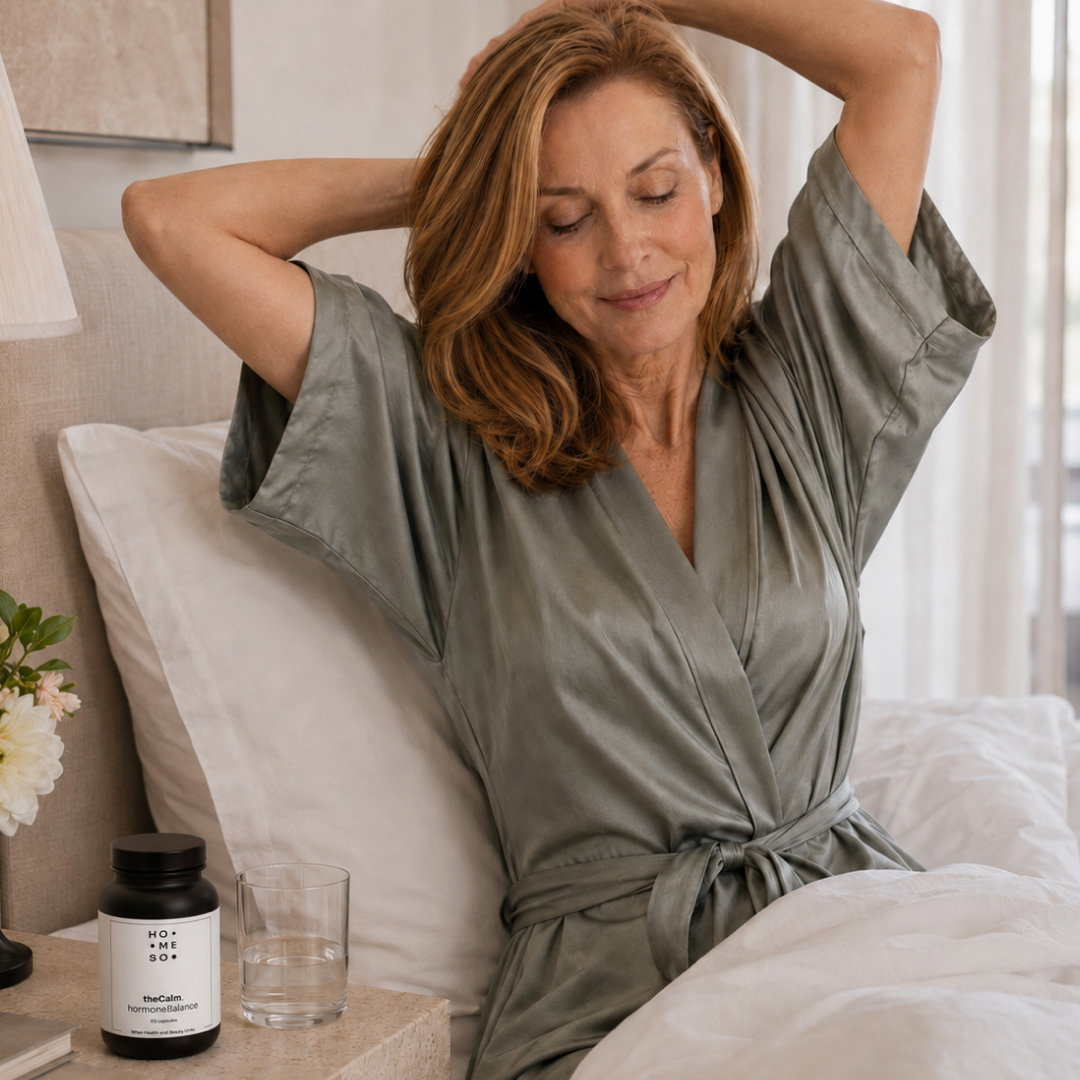
You are exhausted by nine. By eleven, you are wide awake.
The house is finally quiet. The day is over. And that is precisely when your mind decides to run through all of it — the email you never sent, the appointment you keep meaning to book, the conversation that did not go the way you wanted.
Being tired and being able to sleep, it turns out, are two entirely different things.
Why you cannot switch off
For a lot of us, the evening is the first genuinely quiet moment in fourteen hours. Which makes it the first opportunity the mind has had to process anything. So it processes everything. All at once. At the exact moment you were hoping to stop.
You are physically done. Your body has nothing left. And yet the second your head touches the pillow, your mind produces a clear, well-organised list of everything you have not dealt with.
Being exhausted and being able to fall asleep are not the same thing. Tiredness is one system; the ability to disengage is another. When the second one is still running, the first one cannot do much about it.
What feels like a problem with sleep often begins earlier, in the absence of any real transition between a demanding day and bedtime. The thinking was always going to happen — there simply was not anywhere earlier in the day to put it.
This is why people describe it as tired but wired — and why going to bed earlier so rarely solves it. Going to bed earlier with the same busy mind simply gives you longer to lie there.
And then you wake at three
For many people the night has a second act. You fall asleep eventually — and then wake at three or four, unexpectedly alert.
Night-time waking has many causes, and brief awakenings are a normal part of sleep. Sleep patterns also change as we get older, and a warm bedroom, a glass of wine with dinner or a stressful week can all influence how settled the night feels.
The two halves of the night are often connected. A mind that will not disengage at eleven is frequently the same mind that switches straight back on at three — which means you are not managing two separate problems, but one, at both ends of the night.
Does sleep affect how your skin looks?
Research suggests that insufficient sleep can affect facial appearance and certain measurable skin parameters. Studies have reported changes including lower skin hydration, increased transepidermal water loss and a more tired-looking facial appearance following sleep restriction.[1,2] Psychological stress has also been associated with changes in epidermal barrier function.[3]
After a poor night's sleep, you may notice:
- A tired-looking complexion
- More noticeable under-eye circles
- Duller-looking skin
- A less refreshed appearance
Sleep does not prevent skin ageing or treat skin concerns. Skin appearance is influenced by many factors, including age, sun exposure, genetics, hormones, nutrition, stress, environment and skincare habits.
But good-quality rest can be considered part of the wider lifestyle picture, alongside consistent skincare and other healthy habits.
What actually helps
Not a fourteen-step routine. Six small, repeatable habits that make the transition from day to night feel more deliberate.
Leave a gap between the last task and bed. Not a routine — a gap. Around thirty minutes between the final useful thing you do and getting into bed. The mind does not stop on command; it stops with a run-up. Going from answering messages to lights-out in four minutes asks for something the brain cannot deliver, and the thinking you skipped simply happens later, horizontally.
Start with the morning, not only the night. A consistent wake time — including Sunday — and ten or fifteen minutes of daylight within an hour of waking give your body clock its timing cues. Instead of focusing only on bedtime, consider how consistently your day begins.
Put tomorrow on paper. In a laboratory study of 57 healthy young adults, participants who spent five minutes before bed writing a specific to-do list fell asleep faster than those who wrote about tasks they had already completed, with more specific lists associated with shorter sleep onset.[4] It was a small study in young adults and should not be read as a treatment for insomnia — but putting unfinished tasks somewhere other than your head may be worth trying.
Be honest about the evening glass of wine. Alcohol can make you feel sleepy at first and disrupt sleep later in the night. If you regularly wake during the second half of the night, evening alcohol is the first thing worth testing for a fortnight.
Keep the bedroom cooler than feels comfortable. Falling asleep depends on your core temperature dropping, and a warm bedroom works directly against it.
If you wake, try not to turn it into a battle. Do not check the time — knowing it is 3:14 gives you something to calculate. Keep the lights low. If you are still awake and becoming more alert after twenty minutes or so, get up briefly for something calm and undemanding, and go back when you feel sleepy. Lying in the dark becoming frustrated teaches your body that bed is where you are frustrated.
None of this is dramatic. That is rather the point: the most useful evening habits are the ones simple enough to repeat.
If you only take one thing from that list, take the gap. Half an hour between the last useful thing you do and getting into bed changes more than any of the others, and it costs nothing.
If difficulty sleeping has persisted for months and is affecting how you function during the day, talk to a healthcare professional. Chronic insomnia is treatable, and cognitive behavioural therapy for insomnia (CBT-I) is widely used as a first-line behavioural treatment. Everything above is for ordinary bad stretches — not a substitute for that conversation.
Building an evening that ends properly
Most evening advice assumes you have ninety unclaimed minutes. You probably do not.
What helps is not a longer routine but a clearer edge — a recognisable point where the working part of the day ends and the evening becomes yours. For many people, skincare already provides something like this: a familiar sequence that marks the transition from doing to winding down.
Where does theCalm. hormoneBalance fit in?
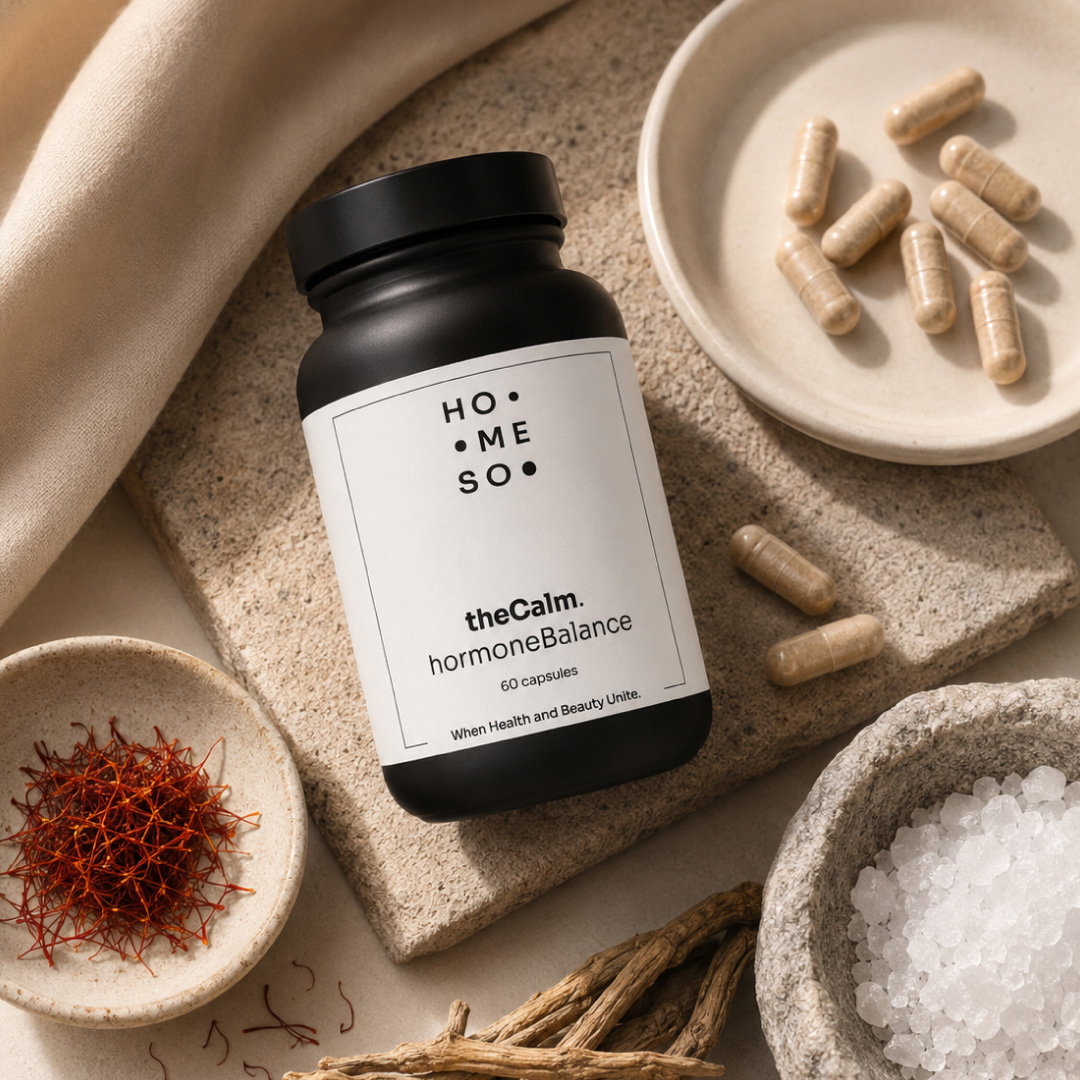
That edge is where theCalm. sits.
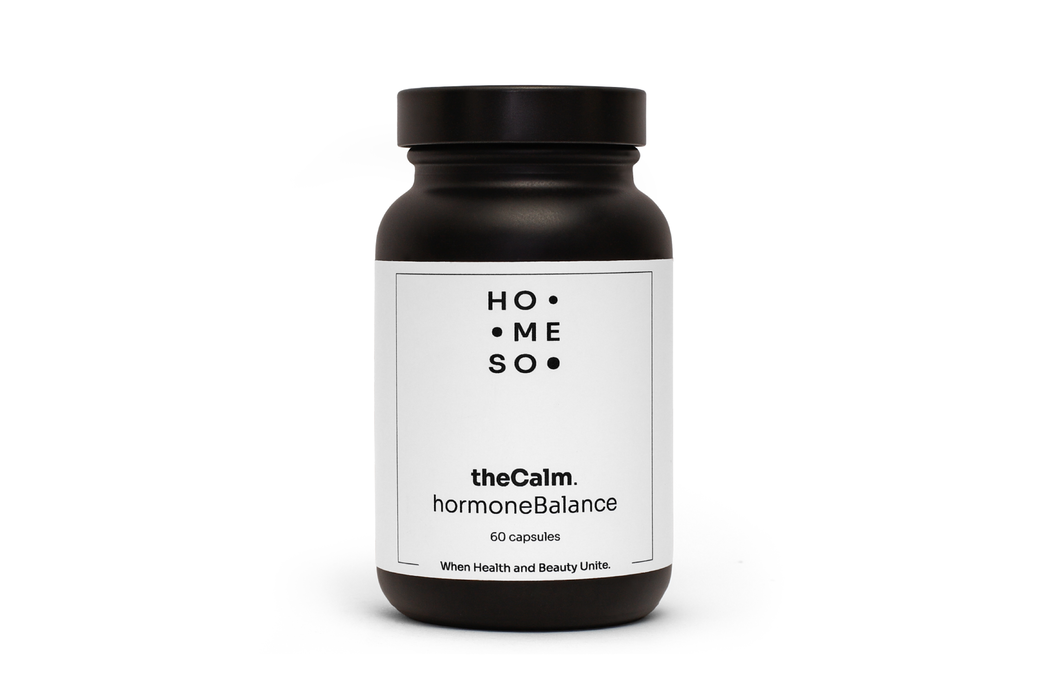
HoMEso theCalm. hormoneBalance is a food supplement for healthy adults, developed to complement a consistent evening routine. It is not presented as a treatment for insomnia or any other sleep disorder. Its place here is as part of the wider evening ritual.
Rather than building the formula around a single ingredient, theCalm. brings together seven key components:
- Magnesium bisglycinate
- Green tea leaf extract, providing L-theanine
- KSM-66® ashwagandha root extract — a branded extract made to a defined specification
- Valerian root extract
- Saffron stigma extract — hand-harvested, and among the most costly botanicals in the world by weight
- Vitamin B6
- Melatonin
The botanical extracts are standardised for specified compounds, including withanolides in KSM-66® ashwagandha, valerenic acids in valerian, and crocins and safranal in saffron, according to the specifications of the relevant product and market.
Why does standardisation matter?
Two extracts from the same plant can differ considerably depending on the raw material, the extraction method and the specification.
A standardised extract is produced to a defined specification for selected marker compounds, which means greater consistency from batch to batch — and more information about what is in the capsule than the plant name alone can give you.
theCalm. is produced in the EU in a GMP-certified facility.
Ingredient amounts, product specifications and recommended daily intake may differ between markets. For the composition and directions applicable to your country, see the official theCalm. hormoneBalance product page.
Seven key components. One considered evening formula.
Where does theCalm. fit into a HoMEso evening?
Your cleanser, serums and creams form the topical part of your routine. theCalm. takes a different place — as a food supplement incorporated into the moment when you begin to leave the demands of the day behind.
A HoMEso evening might look like this:
- Gentle cleansing.
- Active skincare products as needed.
- Moisturising or overnight skincare.
- theCalm. hormoneBalance, taken according to the directions provided for your market.
- A quieter, screen-free transition towards bedtime.
Discover theCalm. hormoneBalance →
What nutritional benefits does theCalm. hormoneBalance provide?
Magnesium and vitamin B6 contribute to the normal functioning of the nervous system and to the reduction of tiredness and fatigue.
Vitamin B6 also contributes to the regulation of hormonal activity.
These recognised nutrient functions form part of the nutritional foundation of theCalm. hormoneBalance.
Why is it called hormoneBalance?
The name reflects the inclusion of vitamin B6, which contributes to the regulation of hormonal activity.
It does not mean that theCalm. hormoneBalance treats hormonal imbalance, hormonal disorders or menopause symptoms.
It is a food supplement intended for healthy adults as part of a varied, balanced diet and healthy lifestyle.
How should I take theCalm. hormoneBalance?
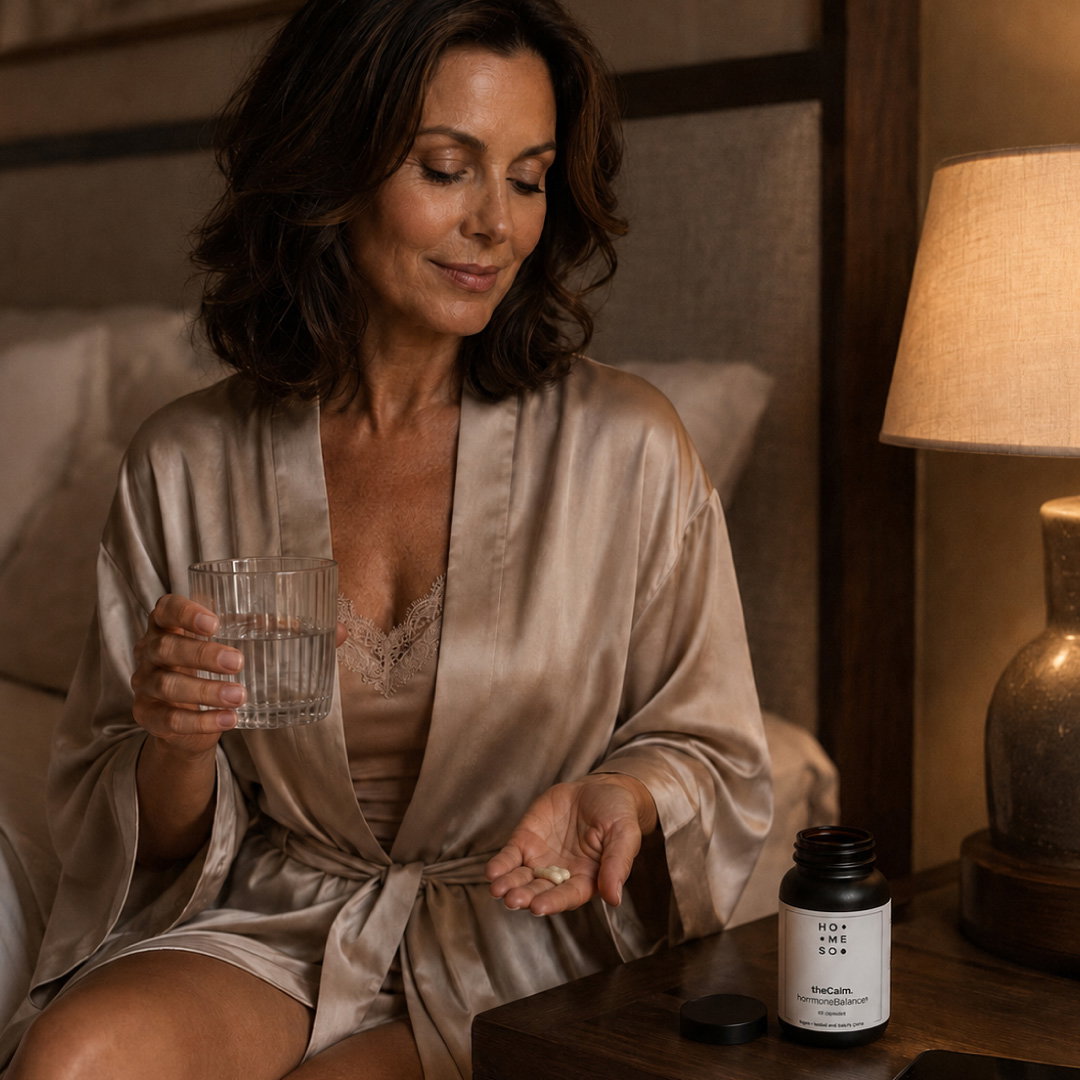
Take two capsules in the evening, shortly before bedtime, with water, and not on an empty stomach.
Timing, directions for use and required warnings may differ between markets. Always follow the instructions and warnings provided on the product packaging or on the official theCalm. hormoneBalance product page for your country, and do not exceed the stated recommended daily intake.
Important information
- theCalm. hormoneBalance is not suitable for pregnant or breastfeeding women, or for anyone under 18.
- Because the formula contains melatonin and botanical extracts, do not drive or operate machinery for at least 5 hours after taking it.
- If you take medication, have a medical condition, are under medical supervision or are unsure whether the product is suitable for you, consult a doctor or pharmacist before use.
- Food supplements should not be used as a substitute for a varied, balanced diet and a healthy lifestyle. Additional warnings and suitability information may apply depending on the market and product specification.
Final thoughts
Beauty is influenced by more than what we apply to our skin. Sleep, stress, skincare and the way we move from day to night all form part of the bigger picture of how looked-after we feel — and how rested we look.
theCalm. hormoneBalance was created to take its place within that wider evening ritual, alongside good skincare and habits simple enough that you might actually keep them.
Discover theCalm. hormoneBalance →

When Health and Beauty Unite.
Frequently asked questions
Why do I wake up during the night?
Night-time waking can have many causes, and brief awakenings can be a normal part of sleep. Stress, alcohol, environment, temperature and changes in sleep patterns may all play a role. If waking is frequent, persists over time or affects how you function during the day, discuss it with a healthcare professional.
Does sleep affect how your skin looks?
Sleep is one of several lifestyle factors that can influence how rested and refreshed your skin appears. Research has also reported measurable changes in certain skin parameters following sleep restriction.[1,2]
How many capsules should I take?
The recommended daily intake is two capsules, taken in the evening, shortly before bedtime, with water and not on an empty stomach. Do not exceed the recommended daily intake stated for your country.
Does theCalm. hormoneBalance contain melatonin?
Yes. Melatonin is one component of the theCalm. hormoneBalance formula. Ingredient amounts and recommended daily intake may differ between markets, so always refer to your local product information.
Does theCalm. hormoneBalance treat sleep problems or menopause symptoms?
No. theCalm. hormoneBalance is a food supplement for healthy adults and is not intended to diagnose, treat, cure or prevent a medical condition.
Who should not take theCalm. hormoneBalance?
It is not suitable for pregnant or breastfeeding women or for anyone under 18. If you take medication or have a medical condition, consult a doctor or pharmacist before use.
References
- Sundelin T, Lekander M, Kecklund G, Van Someren EJW, Olsson A, Axelsson J. Cues of fatigue: effects of sleep deprivation on facial appearance. Sleep. 2013;36(9):1355–1360. doi:10.5665/sleep.2964. PMID: 23997369.
- Léger D, Gauriau C, Etzi C, et al. "You look sleepy…" The impact of sleep restriction on skin parameters and facial appearance of 24 women. Sleep Medicine. 2022;89:97–103. doi:10.1016/j.sleep.2021.11.011. PMID: 34971928.
- Maarouf M, Maarouf CL, Yosipovitch G, Shi VY. The impact of stress on epidermal barrier function: an evidence-based review. British Journal of Dermatology. 2019;181(6):1129–1137. doi:10.1111/bjd.17605. PMID: 30614527.
- Scullin MK, Krueger ML, Ballard HK, Pruett N, Bliwise DL. The effects of bedtime writing on difficulty falling asleep: a polysomnographic study comparing to-do lists and completed activity lists. Journal of Experimental Psychology: General. 2018;147(1):139–146. doi:10.1037/xge0000374. PMID: 29058942.